
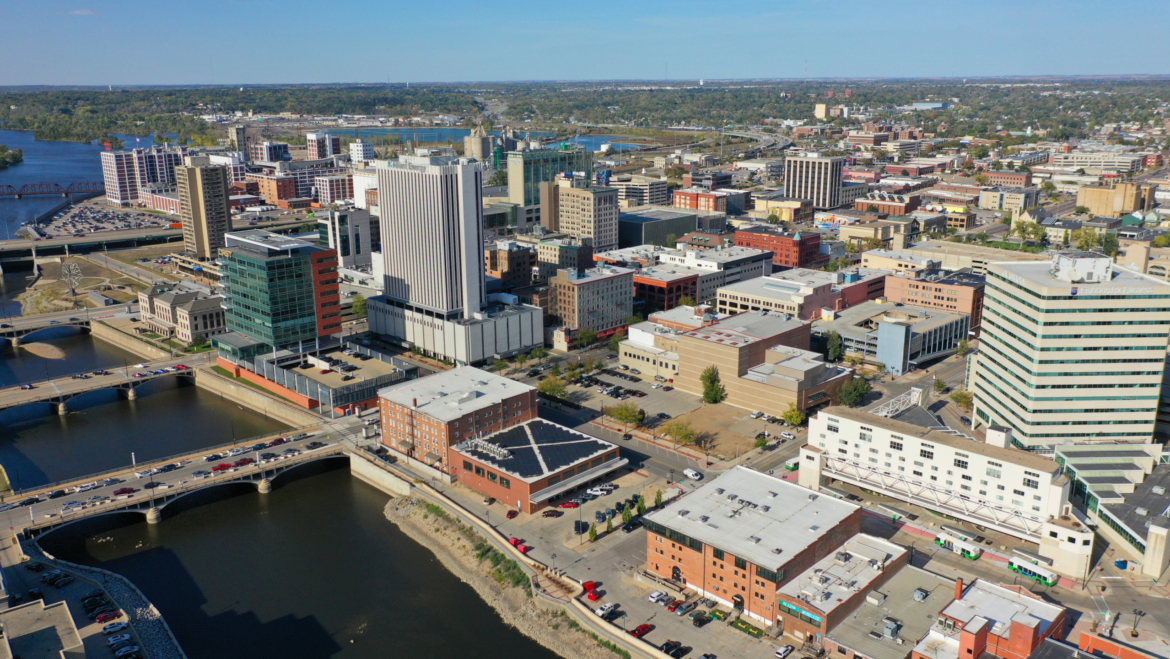
The 2025 Cedar Rapids Metro commercial real estate market entered a new phase of growth and transition, defined by record-setting industrial investment, resilient retail fundamentals, and evolving office and multifamily dynamics. For owners, investors, and occupiers across Eastern Iowa, the Cedar Rapids metro continues to solidify its position as a regional hub for technology infrastructure, healthcare, services, and mixed-use community development.
2025 Cedar Rapids Metro Commercial Real Estate Overview
In 2025, the Cedar Rapids commercial real estate market was shaped by four key factors: AI-driven industrial development, hybrid workplace trends, retail stability, and sustained multifamily demand. The metro’s inventory includes approximately 14.9 million square feet (SF) of industrial, 3.5 million SF of CBD office, 5.8 million SF of suburban office, and 9.3 million SF of retail/service space, building a diverse and balanced commercial real estate sector.
Industrial Market: Data Centers and AI-Driven Growth in Cedar Rapids
Industrial users, data center operators, medical providers, professional services firms, retailers, and multifamily investors all found distinct opportunities in the Cedar Rapids area, from downtown redevelopment to greenfield industrial land on the southwest side. As national capital increasingly targets secondary and tertiary markets with strong infrastructure and workforce, Cedar Rapids continues to stand out in Eastern Iowa’s commercial real estate landscape.
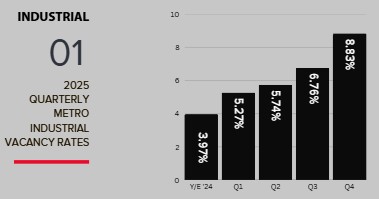
The industrial market was the clear growth engine of the Cedar Rapids metro in 2025, driven by significant artificial intelligence (AI) and data center investment. The market totals roughly 14,900,000 SF, with vacancy moving from 3.97% entering 2025 to 8.83% by year-end as new product and large blocks of space came online.
Average asking rental rates ended the year at $7.08/SF NNN, after beginning 2025 at $7.76/SF NNN, with trends influenced by the addition of properties such as the Smurfit Westrock facility on Blairs Ferry Road NE. While vacancy increased, it did so from historically tight levels, signaling a market that is expanding rather than softening as inventory grows and more users gain space options.
The transformative story for Cedar Rapids industrial real estate is the rise of AI-related data center demand on the southwest side of the metro. Google and QTS both broke ground on large-scale data centers, bringing a combined potential investment of approximately 2.3 billion and drawing contractors, vendors, and allied industrial users into the market.
This wave of data center development is shifting the industrial base from a traditional warehouse and storage orientation toward technology, utility-intensive uses, and specialized infrastructure. With cost-effective land, strong utility capacity, and excellent transportation connectivity, Cedar Rapids is well-positioned to continue attracting data center operators, suppliers, logistics users, and advanced manufacturing tenants.
Office Market: CBD Redevelopment and Suburban Healthcare Demand
The Cedar Rapids office market in 2025 reflected national trends of elevated vacancy and ongoing workplace transformation but also showcased targeted reinvestment and adaptive reuse opportunities.
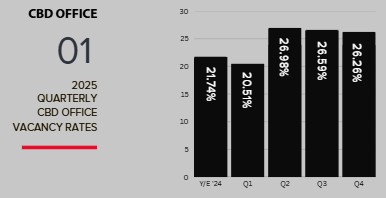
The Central Business District (CBD) office market includes approximately 3,500,000 SF. Vacancy increased from 21.74% entering 2025 to 26.26% at year-end, driven primarily by the 186,355 SF former US Bank corporate campus coming to market in the second quarter.
Despite this upward vacancy pressure, the downtown Cedar Rapids office market remains active, with notable commitments and investments. Cedar Rapids Bank & Trust opened a new 34,000 SF office building, Community Savings Bank established a branch at Cedar River Tower, and the University of Iowa Hospitals and Clinics purchased the building at 411 10th Street SE where it occupies a majority of the space.
Flexible office providers are also expanding, with Regus signing an approximately 11,000 SF lease on the ground floor of 200 2nd Avenue SE, further supporting downtown’s role as a professional, financial, and service hub. Looking ahead, adaptive reuse of legacy buildings, such as the former Guaranty Bank redevelopment incorporating residential and commercial space, is expected to remain a key strategy for right-sizing the CBD office inventory.
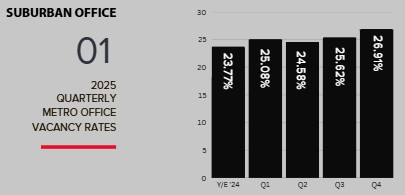
The suburban office market in the Cedar Rapids metro consists of about 5,800,000 SF and continued to be reshaped by healthcare, professional services, and hybrid work patterns throughout 2025. Vacancy increased from 23.77% to 26.91% during the year, while the average asking rental rate settled at $11.49/SF NNN, slightly below the $11.76/SF NNN level at the start of 2025.
Medical, dental, and therapeutic providers remain among the most active suburban office users, supporting demand for locations with strong access, parking, and patient convenience. Hybrid work has firmly become the norm, driving interest toward smaller footprints, shared amenities, and flexible layouts rather than large, traditional corporate office campuses.
Limited speculative office construction reflects a focus on backfilling existing buildings, targeted renovations, and adaptive reuse instead of ground-up development. Key transactions included office investment sales, medical office acquisitions, and owner-user projects, underscoring continued confidence in well-located suburban assets that can meet evolving user expectations.
Retail and Service Real Estate: Stable Corridors and Adaptive Reuse
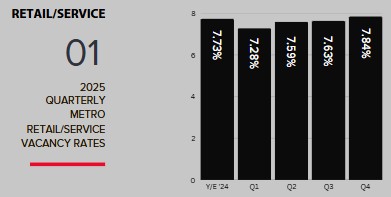
Among the major submarkets, retail/service exhibited the most stable performance in the Cedar Rapids metro during 2025. The market totals around 9,300,000 SF, with vacancy holding essentially steady between 7.73% and 7.84% throughout the year.
Average asking rental rates finished 2025 at $13.41/SF NNN, a modest decrease from $14.64/SF NNN at the beginning of the year. While some restaurants and retailers closed, new concepts were generally quick to backfill second‑generation space, particularly in established corridors and high-traffic nodes.
The Westdale area on Cedar Rapids’ southwest side remained a focal point for retail activity and reinvestment. 7‑Brew purchased the former Sugarfire BBQ building, Texas Roadhouse upgraded into a larger building, Tractor Supply moved forward with a new store, and the former AMC Theater is slated for conversion to a trampoline park, illustrating how experience-driven and service-focused users continue to leverage brick-and-mortar locations.
Creative adaptive reuse is also playing an increasing role, with assets like the former Westdale Used Car Superstore at 3220 Wiley Blvd SW being repurposed for new users such as Kubota. Overall, the Cedar Rapids retail/service market demonstrates that well-located centers, necessity-based retail, and experiential concepts can thrive even as e-commerce continues to influence consumer behavior.
Multifamily and Mixed-Use Development in the Cedar Rapids Metro
The multifamily sector in the Cedar Rapids metro remained healthy in 2025, supported by elevated interest rates, high for-sale home prices, and constrained single-family inventory, all of which kept many households in the rental market. Approximately 653 units were planned or started during 2025, reflecting a robust but moderating development pipeline.
Vacancy rates tightened further as construction ramped up on the Google and QTS data center projects, which brought additional construction workers and related demand into the region. Existing multifamily vacancy generally ranged from 3–5% in newer product and 5–10% in older properties, supporting solid occupancy levels across the metro.
Investment activity remained active, with 17 confirmed multifamily transactions totaling 364 units and an average capitalization rate around 7.39% for 2025, slightly below the 7.51% figure reported in 2024. This trend suggests steady investor interest in Cedar Rapids apartments, even in the face of higher borrowing costs and tighter underwriting.
Large-scale mixed-use projects underscore the ongoing demand for walkable, amenity-rich environments in and around the metro. NewBo Loftus delivered a five-story building in Cedar Rapids that includes 186 multifamily units and 11,000 SF of commercial space, while projects in Marion and Hiawatha such as Broad & Main on 6th, Ingram Village, and the former Marion Library site redevelopment are adding townhomes, apartments, and commercial space in community-oriented settings.
Why Cedar Rapids Remains a Strategic Commercial Real Estate Market
For investors, developers, and occupiers evaluating opportunities across Iowa and the broader Midwest, the Cedar Rapids metro offers a compelling combination of industrial growth, diversified demand drivers, and long-term stability.
Key differentiators include:
- AI and data center investment from Google and QTS positioning Cedar Rapids as a regional technology infrastructure hub.
- A growing industrial base supported by transportation connectivity, unility capacity, and cost-effective sites.
- A resilient retail/service market anchored by necessity retail, restaurants, and experiential users in strong trade areas like Westdale.
- Multifamily fundamentals supported by strong occupancy, a moderating construction pipeline, and consistent investor interest.
- Office opportunities driven by adaptive reuse, medical and professional office demand, and selective reinvestment in downtown and suburban areas.
As the market continues to evolve, Cedar Rapids remains a prime location for users and investors seeking long-term value in industrial, office, retail, and multifamily properties across Eastern Iowa.
Contact GLD Commercial at 319.731.3400 for additional information.