
Cedar Rapids Suburban Office Market 2025
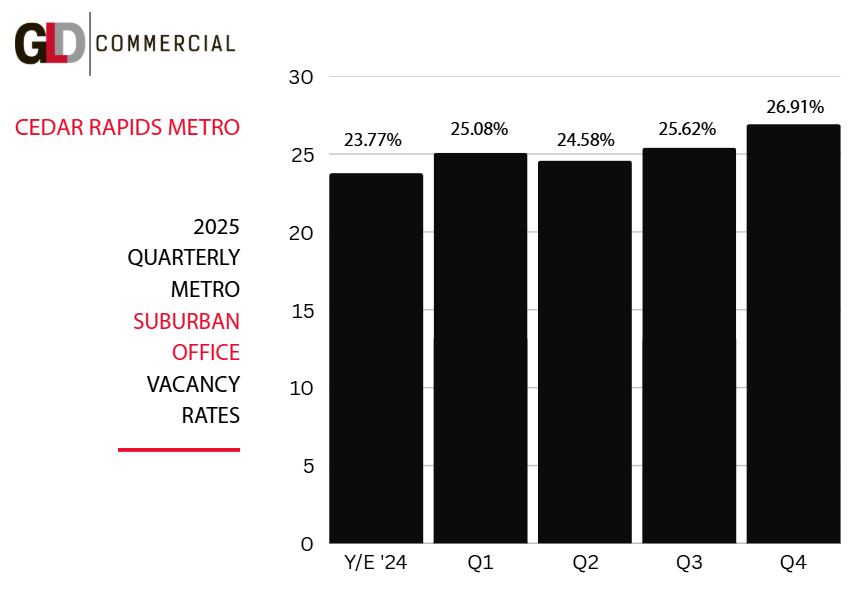
The Cedar Rapids suburban office market includes roughly 5.8 million square feet of space, with vacancy moving higher in 2025 as companies continued to right-size and reconfigure their offices. Average asking rents edged down slightly on a net basis, reflecting more competition among commodity properties even as well-located buildings maintained stronger pricing. At first glance, rising vacancy and modest rent compression suggest a market under pressure, but the story on the ground is more nuanced. The sector is being reshaped by who is leasing space and how that space is used, not simply by how much space is occupied.
Why Higher Vacancy Does Not Equal Weak Demand
Elevated vacancy in the suburban submarket is heavily tied to hybrid work, space efficiency, and corporate footprint reductions rather than a collapse in tenant demand. Many users still need physical office space, but they require less of it and demand that it perform better. As a result, older, generic office buildings without amenities, flexibility, or strong access face the most pressure. Meanwhile, properties that match current workplace strategies continue to attract interest and leases.
How Healthcare and Hybrid Work Are Redefining Demand
In 2025, leasing activity was driven less by traditional large corporate expansions and more by:
- Healthcare users, including medical, dental, and therapy practices
- Professional services firms rightsizing footprints for hybrid work
- Tenants prioritizing function, efficiency, and client access over raw square footage
Hybrid work is now standard rather than a short-term experiment. That shift is pushing demand toward smaller, more efficient footprints, amenity-rich environments, and locations with strong access, parking, and convenience close to residential neighborhoods.
What This Means for Landlords and Investors
For landlords and investors, the message is clear: vacancy is rising, but demand has not disappeared, it has shifted. Commodity suburban office space without updates or differentiation faces the greatest headwinds. In contrast, well-located, flexible, and upgraded properties that can accommodate medical buildouts, shared amenities, and hybrid layouts are capturing the majority of leasing activity. Capital allocation toward improvements that enhance usability and tenant experience is increasingly critical.
From New Construction to Reuse and Repositioning
Higher vacancy, elevated interest rates, and increased construction costs have kept speculative ground-up suburban office development limited. Instead, the focus has shifted to: backfilling existing vacancies, pursuing adaptive reuse of underperforming assets, and making targeted capital improvements to keep properties competitive. Owners are repositioning older buildings to attract healthcare users, services, and smaller office tenants that value convenience and flexibility over large contiguous blocks of space.
Outlook for Cedar Rapids Suburban Office
Suburban office in Cedar Rapids is no longer about scale, it is about usability. Properties that align with healthcare demand, hybrid work patterns, and amenity expectations will define the next cycle of absorption. For investors and owners who are willing to adapt, the suburban market offers opportunities to capture evolving demand through strategic repositioning and tenant-focused design.
Interested in learning more about the Cedar Rapids suburban office market and other submarkets? Contact GLD Commercial at 319.731.3400 or visit gldcommercial.com for the full 2025 Cedar Rapids Metro Commercial Real Estate Report.
The Cedar Rapids suburban office market totals roughly 5.8 million square feet of space, spanning medical, professional services, and traditional office users.
Vacancy is moving higher primarily because companies are right-sizing footprints, embracing hybrid work, and reconfiguring how they use space, not because demand has disappeared.
No. Rising vacancy is tied to space efficiency and hybrid work trends, while many tenants still need office space that performs better, in more efficient and flexible layouts.
Demand is led by healthcare users (medical, dental, therapy), professional services firms, and tenants prioritizing function, efficiency, and client access over large footprints.
Hybrid work is now standard, pushing demand toward smaller, efficient suites in amenity-rich buildings with strong access, parking, and locations close to residential neighborhoods.
Well-located, flexible, and upgraded properties that can support medical buildouts, shared amenities, and hybrid layouts are capturing most of the leasing activity.
Older, generic office buildings without amenities, flexibility, or convenient access face the greatest headwinds in attracting and retaining tenants.
Speculative ground-up suburban office construction is limited due to higher vacancy, elevated interest rates, and increased construction costs.
Owners are focusing on backfilling existing vacancies, adaptive reuse of underperforming buildings, and targeted capital improvements to keep assets competitive.
Adaptive reuse involves repositioning older or underperforming office properties—often into healthcare, service, or smaller tenant configurations—to better match current demand.
The market is shifting from a focus on scale to a focus on usability. Properties aligned with healthcare demand, hybrid work patterns, and modern amenity expectations are best positioned for the next wave of absorption.
GLD Commercial specializes in Cedar Rapids–area office leasing, investment sales, and advisory, helping landlords reposition assets and tenants secure efficient, strategically located space.
GLD Commercial can evaluate building positioning, recommend value-add improvements, design leasing strategies, and market properties to healthcare, professional, and service-oriented users.
For tenants, GLD Commercial provides site selection, lease negotiation, and workplace strategy guidance to align office locations and layouts with hybrid work and client-access needs.
For detailed data and submarket insights, contact GLD Commercial at 319.731.3400 or visit gldcommercial.com to access the full 2025 Cedar Rapids Metro Commercial Real Estate Report.