
Market Overview and Key Metrics
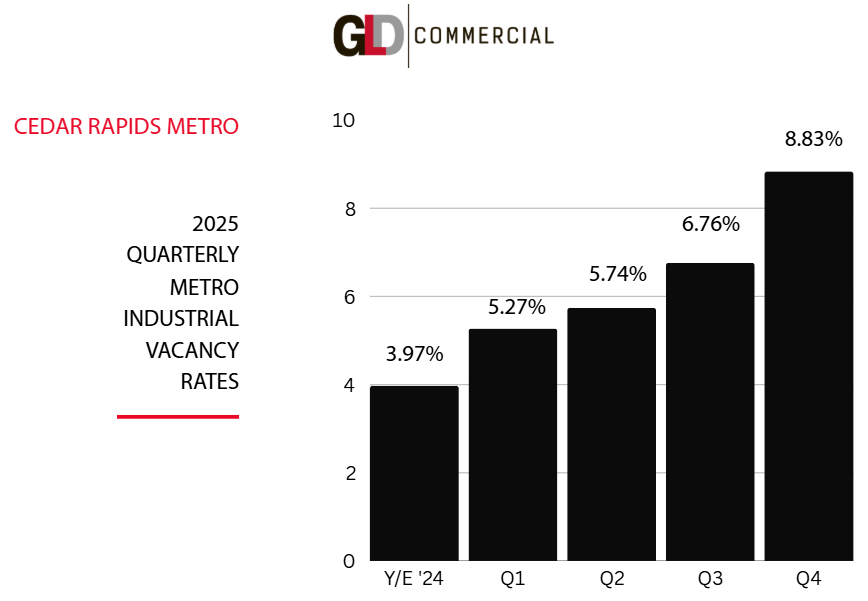
Cedar Rapids’ industrial market did not weaken in 2025; it recalibrated and expanded as new inventory entered an already constrained landscape. Total industrial inventory now stands at approximately 14.9 million square feet, with vacancy rising from 3.97% to 8.83% as additional space, including the Smurfit Westrock property, came online. Average asking rents ended the year at 7.08 dollars per square foot NNN, down from 7.76 dollars, reflecting the impact of new supply rather than a collapse in demand.
Why Rising Vacancy Still Signals Growth
At first glance, higher vacancy and softer rental rates can look like a cooling market. In reality, this is what growth often looks like when fresh product hits a previously tight environment and tenants gain more options. A vacancy level near 9 percent is still structurally healthy for a growing Midwest industrial market, especially one adding larger blocks of space. Instead of signaling distress, the current metrics indicate an expansion phase supported by new deliveries.
Data Centers and AI Demand Reshaping Industrial
A key storyline in 2025 is the surge in AI-driven data center activity. Google and QTS have broken ground on major data center projects in Cedar Rapids, representing roughly 2.3 billion dollars in combined potential investment and marking a turning point for the local industrial base. These projects are already generating spillover leasing from contractors, suppliers, and infrastructure users tied to construction and future operations. The result is not just traditional industrial absorption but broader ecosystem expansion around technology, utilities, and logistics.
Implications for Investors and Occupiers
For investors and occupiers, pricing pressure is tied primarily to the timing and scale of new supply, not weakening fundamentals. Industrial demand in Cedar Rapids is diversifying beyond warehouse and distribution into data infrastructure, power-intensive uses, and specialized support services. Underwriting decisions that rely only on historical industrial comparables risk missing how quickly the demand profile is shifting.
Cedar Rapids as a Technology-Enabled Industrial Hub
Cedar Rapids is transitioning from a logistics-focused industrial market to a technology-supported infrastructure hub. The metro offers cost-effective land, strong utility capacity critical for data centers, and central transportation access that supports both regional distribution and digital infrastructure. These fundamentals position the Cedar Rapids industrial real estate market for continued, AI-aligned growth.
Interested in the full picture? Contact GLD Commercial at 319.731.3400 or visit gldcommercial.com for the complete 2025 Cedar Rapids Metro Commercial Real Estate Report.