
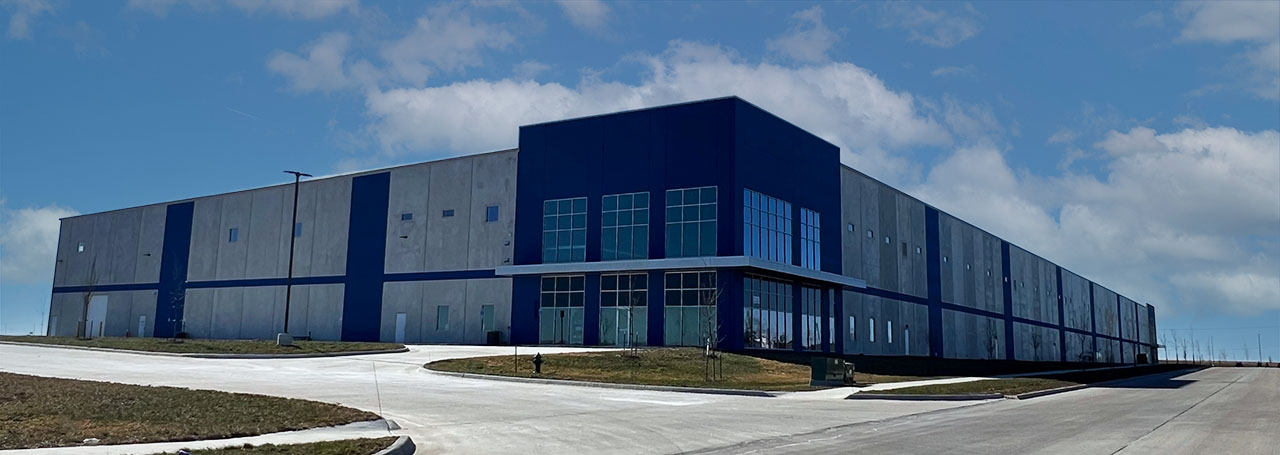
The story driving Cedar Rapids industrial right now is investment at a scale the metro hasn’t seen before. Over $1.3 billion in data center investments have been announced in the Cedar Rapids metro, with Google and QTS both under construction at the Big Cedar Industrial Center. That level of activity creates a ripple effect: contractors, subcontractors, and supply chain operators all need space.
According to GLD Commercial’s 2025 industrial market report, the average asking rental rate is approximately $7.08/SF NNN. That’s competitive compared to larger Midwest markets and well below the cost of new construction, which makes existing warehouse inventory particularly attractive right now.
Key Market Stats at a Glance
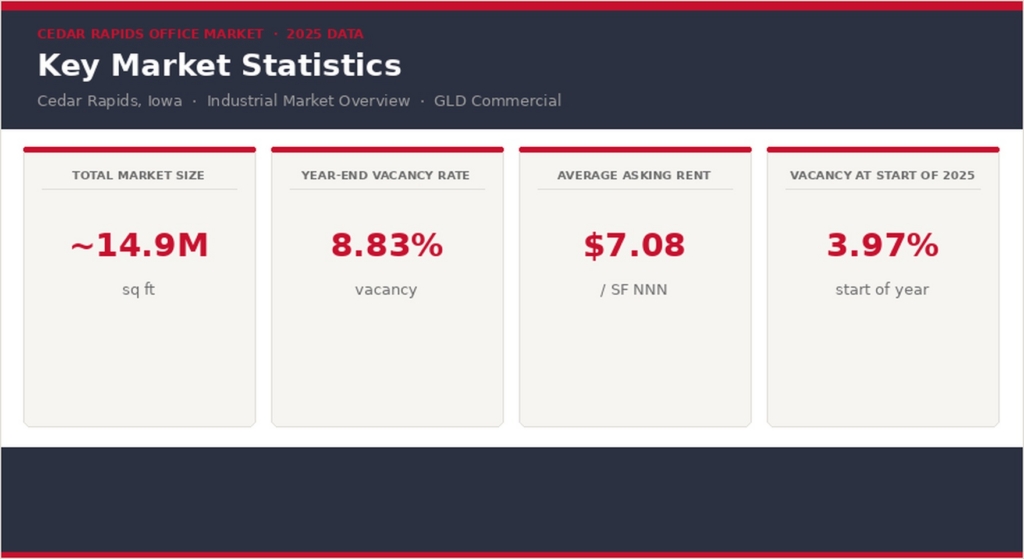
What this means for tenants: You have more choices than you did two years ago. But quality spaces at functional rental rates still move quickly. Don’t assume a longer search window than you need.
Why Location Along the I-380 Corridor Matters
Not all Cedar Rapids industrial submarkets are equal. Where your warehouse sits determines your operating costs, your access to labor, and your ability to move product efficiently.
The I-380 Corridor
The I-380 corridor is the spine of Cedar Rapids industrial activity. Properties here offer direct north-south access connecting Cedar Rapids to Iowa City, the Quad Cities, and beyond. For distribution and logistics operations, this is the first submarket to evaluate.
Northeast Cedar Rapids
The northeast quadrant, including areas around Blairs Ferry Road NE and Collins Road NE, has seen significant new industrial development. The Smurfit Westrock property on Blairs Ferry Road NE, which added substantial square footage to the market in 2025, is in this submarket. New speculative warehouses of various sizes continue to be built here.
Southwest Cedar Rapids
Southwest Cedar Rapids has historically hosted food and agriculture-related manufacturing, consistent with Cedar Rapids’ identity as the “Grain Processing Capital of the World.” International Flavors and Fragrances recently began construction on a new 47,000 SF food-grade manufacturing facility in this area, a $68 million investment that signals continued confidence in the submarket.
Marion and Hiawatha
For businesses that need proximity to Cedar Rapids but prefer suburban industrial settings, Marion and Hiawatha offer functional warehouse and flex options, often at slightly lower rental rates than core Cedar Rapids locations.
Pro tip: Access to US-30, I-380, and Highway 151 varies significantly by submarket. Before committing to a location, map your inbound freight routes and your delivery destinations. A property that looks central on a map can add real time and cost to daily operations.
What to Look for in a Cedar Rapids Warehouse Space
Once you’ve identified the right submarket, the physical specs of the building determine whether it actually works for your operation. Here are the factors that matter most.
Clear Height
Clear height is the usable vertical space from the floor to the lowest obstruction (beams, sprinkler heads, lights). For general warehousing, 24-foot clear height is a minimum for modern racking systems. Distribution operations often require 28 to 36 feet. Older Cedar Rapids industrial buildings frequently have 18 to 22-foot clear heights, which limits racking options and forklift access.
Dock Doors and Drive-In Access
- Dock-high doors (typically 48 to 52 inches off the ground) allow semi-trailers to back directly to the building for loading and uploading.
- Drive-in doors (grade-level) are better for smaller trucks, forklifts, and direct floor-level access.
- The ratio of dock doors to square footage matters. A 50,000 SF building with two dock doors will create bottlenecks for high-volume operations.
Power and Electrical Capacity
Manufacturing and cold storage users need to pay close attention to electrical service. Many older Cedar Rapids industrial buildings were built for lighter uses and may not have the 3-phase power or amperage capacity required for modern equipment. Upgrading electrical service is expensive and time-consuming, so verify this before signing.
Sprinkler Systems and Fire Suppression
ESFR (Early Suppression Fast Response) sprinklers are the standard for modern warehousing with high-pile storage. If you’re stacking product above 12 feet, confirm the building’s fire suppression system meets code for your specific use. This is often overlooked until a fire marshal inspection creates a problem.
HVAC and Climate Control
Standard warehouse HVAC is fine for most distribution uses. Food-grade, pharmaceutical, or temperature-sensitive operations require specialized systems. Verify what’s in place and what it would cost to modify before negotiating lease terms.
Understanding Industrial Lease Terms in Cedar Rapids
Most Cedar Rapids industrial leases are structured as NNN (triple net), meaning the tenant pays base rent plus their proportionate share of property taxes, insurance, and maintenance. This is standard in the market, but the details vary significantly.
A few things to negotiate carefully:
- Tenant Improvement Allowance (TIA): Landlords in a market with healthy vacancy are more likely to offer TI dollars for buildout. In a tighter market, you may need to fund your own improvements.
- Lease term: Longer terms (5-10 years) typically come with better rates and more landlord investment in the space. Shorter terms give you flexibility but often at a higher per square foot (SF) cost.
- Renewal options: Lock in renewal options at defined rates or defined escalation caps. You don’t want to build out a space and then face a sharp rent increase at renewal.
- Exclusivity and use clauses: If you’re a multi-tenant industrial park, confirm your permitted use doesn’t conflict with other tenants and that your operations are covered under the lease’s use clause.
Average asking rent in Cedar Rapids industrial was $7.08/SF NNN in 2025. That’s your baseline for negotiations. Properties with superior specs (higher clear height, more dock doors, newer HVAC) will command more. Older second-generation space will be priced below that benchmark.
For a full picture of available industrial properties in Cedar Rapids, browse current listings or contact GLD Commercial for off-market options that never hit the public listing services.
How to Find the Right Industrial Space Faster
The most efficient path to finding warehouse space in Cedar Rapids isn’t scrolling through listing sites. It’s working with a broker who knows which properties are coming available before they’re listed, which landlords are flexible on terms, and which buildings have hidden issues that will cost you money.
GLD Commercial has represented some of the largest industrial transactions in Cedar Rapids history, including a 200,000 SF warehouse and distribution center for Corteva Agriscience and a 240,000 SF corporate headquarters for BH Factory Outlet. We know this market at a level that online listings simply can’t replicate.
Our tenant representation services are typically provided at no cost to the tenant. The landlord pays the commission. That means you get full-time broker expertise, market data, and negotiating support without adding to your occupancy cost.
Looking for industrial or warehouse space in Cedar Rapids? Contact GLD Commercial and tell us your size, timeline, and operational requirements.
The industrial vacancy rate in Cedar Rapids was approximately 8.83% at the end of 2025. This increase from earlier in the year is primarily due to new construction delivering additional space, not a drop in demand, meaning the market is expanding rather than weakening.
Cedar Rapids has roughly 14.9 million square feet of industrial inventory, including warehouse, distribution, flex, and manufacturing space. Availability varies by submarket and building type, with newer facilities offering more modern features. Contact GLD Commercial at 319.731.3400 for specific availability.
The average asking rent is about $7.08 PSF NNN. Pricing varies based on building quality, location, clear height, and loading capabilities, with newer or high-spec buildings commanding higher rates.
NNN (triple net) means tenants pay base rent plus their share of property taxes, insurance, and maintenance costs. This structure is standard in Cedar Rapids industrial leases and should be carefully reviewed during negotiations.
The I-380 corridor is the primary logistics spine in Cedar Rapids, providing direct access to Iowa City, the Quad Cities, and regional distribution routes. Locations along this corridor typically offer better transportation efficiency and reduced shipping costs.
Key industrial submarkets include:
I-380 Corridor: Best for logistics and distribution access
Northeast Cedar Rapids: New construction and modern warehouses
Southwest Cedar Rapids: Food-grade and manufacturing facilities
Marion and Hiawatha: Lower-cost suburban options with good access
Most modern warehouse users need at least 24-foot clear height. Distribution and high-volume operations often require 28 to 36 feet for efficient racking and vertical storage.
The required number depends on your operation, but high-volume users need multiple dock-high doors to avoid bottlenecks. For example, a 50,000 SF warehouse with only two dock doors may limit throughput and efficiency.
Dock doors allow semi-trucks to load at platform height, while drive-in doors provide ground-level access for smaller vehicles and forklifts. Many facilities benefit from having both.
No. Many older buildings may lack adequate 3-phase power or amperage for modern industrial use. Verifying electrical capacity early can prevent costly upgrades later.
Modern warehouses typically require ESFR (Early Suppression Fast Response) sprinkler systems, especially for high-pile storage. Always confirm compliance with fire codes for your specific use.
Yes. In a market with increasing vacancy, landlords may offer tenant improvement allowances (TI) to secure tenants. The amount depends on lease term, building condition, and overall demand.
Most leases range from 3 to 10 years. Longer lease terms often provide better rental rates and more favorable concessions, while shorter terms offer flexibility at a higher cost.
Working with a GLD Commercial broker is the fastest method. Brokers often have access to off-market properties, upcoming availabilities, and insights that aren’t visible on listing platforms.
In most cases, yes. The landlord typically pays the commission, allowing tenants to benefit from professional representation, market data, and lease negotiation support at no direct cost.
Yes. With over $1.3 billion in data center investment and continued industrial development, Cedar Rapids is experiencing strong growth. This drives demand for warehouse, logistics, and support space across the metro.
Key factors include location, clear height, loading access, power capacity, sprinkler systems, HVAC requirements, and lease terms. Overlooking any of these can significantly impact operational efficiency and long-term costs.
You can search platforms like LoopNet for active listings, but many of the best opportunities are off-market. Working with a local brokerage like GLD Commercial can uncover additional options tailored to your needs.